What Is StuCent? An Open World for Learning
You may be asking: what is StuCent, and is it a learning game that teaches real subjects? StuCent is an open world for learning. Learners explore islands, cities and rooms at their own pace, and parents can learn alongside them.
This post is the front door. It says what the world is, what a learner does in a room, and which tools you will meet. Each tool links to a post with more detail.
What is the StuCent world?
The world is a map. Right now it has 4 islands: Languages, Cambridge, Malaysia and Singapore.
An island is a bundle of learning, such as a curriculum, a syllabus or an institution. A city is one subject on that island. The English city is on the Languages island. Cambridge, Malaysia and Singapore each hold their own maths city.
Inside a city, the map goes smaller step by step:
| Level | What it is |
|---|---|
| Island | A bundle of learning, such as a curriculum, a syllabus or an institution |
| City | One subject on that island |
| District | A band of level, such as A1.1 · First Words |
| House | A course or unit |
| Floor | A chapter of a house |
| Room | One lesson space |
The English city alone has 12 districts and 601 rooms. Read the StuCent world map for the full tour of these six words.
What does a learner do in a room?
In the English city, each room teaches one thing: a grammar point, a set of words or a sound. Take the first room, "Verb be with I and you". A child aged about 6 to 11 does these steps:
- Reads a short lesson with big bold words.
- Hears a sentence and taps the matching picture.
- Fills the gaps in a sentence from a small word bank.
- Puts words in order.
- Listens to short phrases and says each one into the microphone.
Teens get their own version of the room, with a different story and more steps. The tour of the English city walks through it.
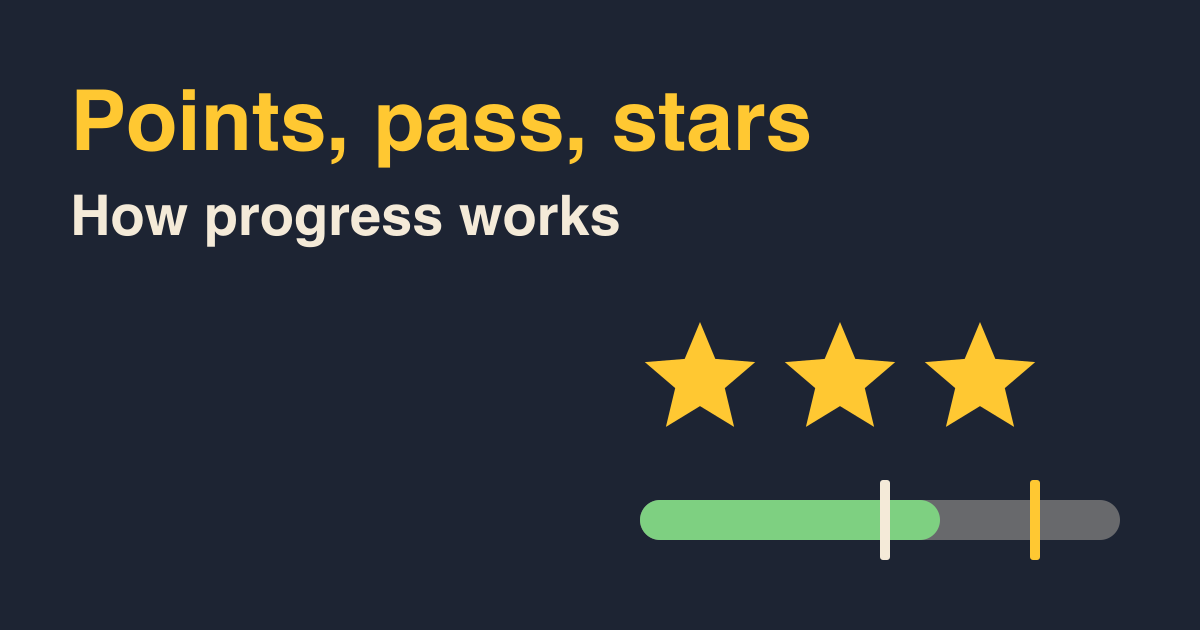
A room also gives a pass mark, a mastery mark and up to 3 stars. A room that builds on other rooms opens only after those are completed.
Which tools will we meet?
Here are the tools, in groups. Each one has its own post.
Finding your way
- The map. Islands, cities, districts, houses, floors and rooms: the StuCent world map.
- Locked rooms. A room can wait for other rooms. Nothing is broken when this happens: how prerequisites work.
Learning in a room
- Lectures. A reading page in a room. Some lectures score what you highlight, so you practise picking the key passages: highlighting in StuCent lectures.
- Flashcards. You rate each card, and the scheduler decides when it comes back. Flashcards are practice only. They do not change your points or stars: StuCent flashcards.
- Coding. Python runs in the browser, with nothing to install. There are also turtle drawing and block coding: try Python in StuCent.
- Speaking. In the English city, guided speaking steps give a model to copy, then compare what your child said with it. Later rooms also have open speaking with no model: shadowing and speaking practice.
Progress and rewards
- Points and stars. Each room has a pass mark and a mastery mark. By default, stars come at 50%, 70% and 90%: how room scoring works.
- Fading knowledge. A room you passed can lose points if you do not practise it. A short return visit helps you win it back: why knowledge fades.
- Quests, badges and certificates. A quest shows the way to a locked room. Badges show on a profile. Certificates carry a code that anyone can check: quests, badges and certificates.
What is in it for parents?
You do not have to stand outside. A family account lets you link your child's account with an invite code. You can then set a daily time limit and allowed hours, and see your child's progress.
You can also join in. In the English city, a clear voice speaks every model phrase first. Your child copies the voice, so you do not need good English to help. StuCent for parents shows each step of the link, the time limits and what you see.
StuCent's privacy details are in the privacy policy.
Ask your child: which room on the map would you like to open first?
What about schools and tuition centres?
Staff can see each student's rooms passed, stars and mastery, by class. The English course for tuition centres and schools explains the roles, how students join, and how to start with one class.
Try it
The quickest way to see StuCent is to open one room. Look at its lesson, answer a few steps, and watch the stars.
Open the first room: Verb be with I and you
Create an account first, so progress is saved. Families can create a family account. Teens can register on their own.
FAQ
Is an island a school subject?
No. An island is a bundle of learning, such as a curriculum, a syllabus or an institution. The subject is the city on that island.
What ages are the English lessons for?
In the English city, every room from A1 to B1 has a version for children of about 6 to 11. Teens have their own version at every level, A1 to C1. A parent can sit beside a younger child.
Can parents see what their child does?
Yes. Link your child's account with an invite code. You then see progress, and you can set a daily time limit and allowed hours.
Where should a new learner start?
Start in the district whose name fits the learner's level. A beginner of any age starts with the first room of the English city.