Shadowing for Kids: Speaking Practice at Home
Many children read English well but go quiet when they have to say it. Shadowing is a simple way to practise speaking: your child plays a short phrase and speaks along with it, a moment behind the voice, copying the words, the rhythm and the speed. For beginners, StuCent starts with an easier version: hear a phrase, then repeat it. In StuCent's English city, your child can do this on a phone, tablet or laptop, even if your own English is basic.
What does a speaking step look like?
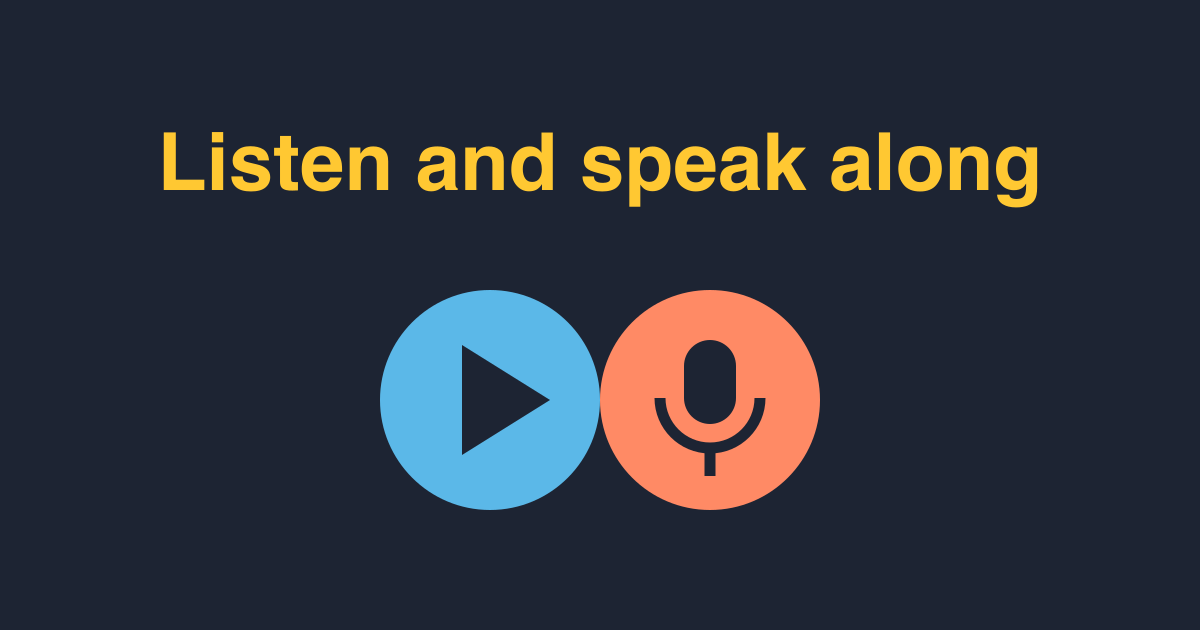
In StuCent, a guided speaking step (like shadowing) has two buttons: listen and record.
- Your child plays a short model, such as "Are you a student?", as many times as they like.
- They press record and say it: after the model (repeat) or along with it (shadowing).
- StuCent writes down what it heard and compares it, word by word, with the model.
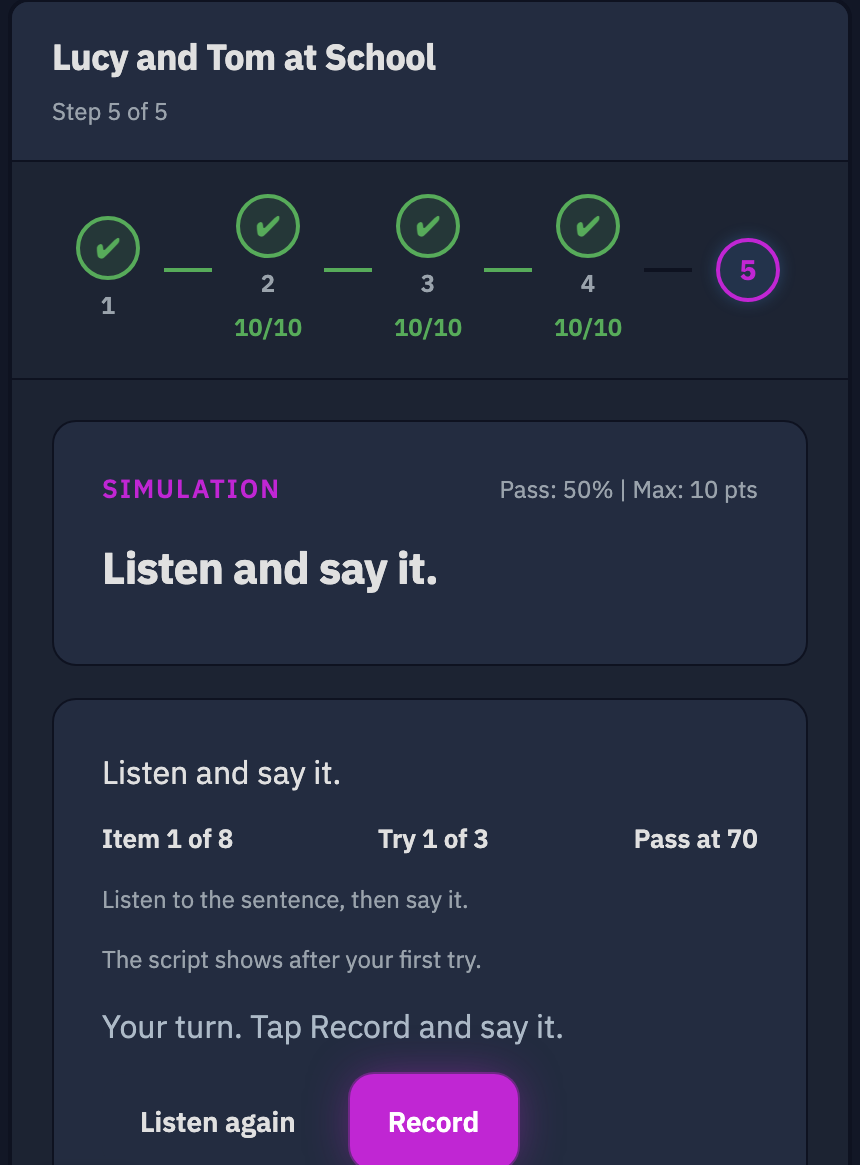
A speaking step in StuCent: listen, then tap Record. The written sentence shows only after the first try, so your child listens first.
Here is how that works on an example:
| The model | "Are you a student?" |
| What your child says | "Are you student?" |
| What StuCent hears | 3 of the 4 words, in the right order |
| The result | Part marks: one word ("a") is missing. Try again. |
Near misses get part credit, and speaking far too slowly lowers the score. StuCent checks that the right words come out in the right order at a natural speed. There is no separate accent score: the aim is clear English, not one particular accent.
Which kinds of speaking step are there?
From easy to harder:
- Repeat: hear one word or a short phrase, say it back.
- Minimal pairs: say two words that differ by one sound, like ship and sheep.
- Stress tap: tap the strong part of a word, then say it.
- Read aloud: read a sentence on the screen.
- Shadowing: speak along with a model sentence.
Later rooms add freer speaking: answering a question, describing a picture or a short role play. There is no model to copy, so StuCent's AI marks these answers against a short checklist; in a school or tuition centre, staff can check the marks.
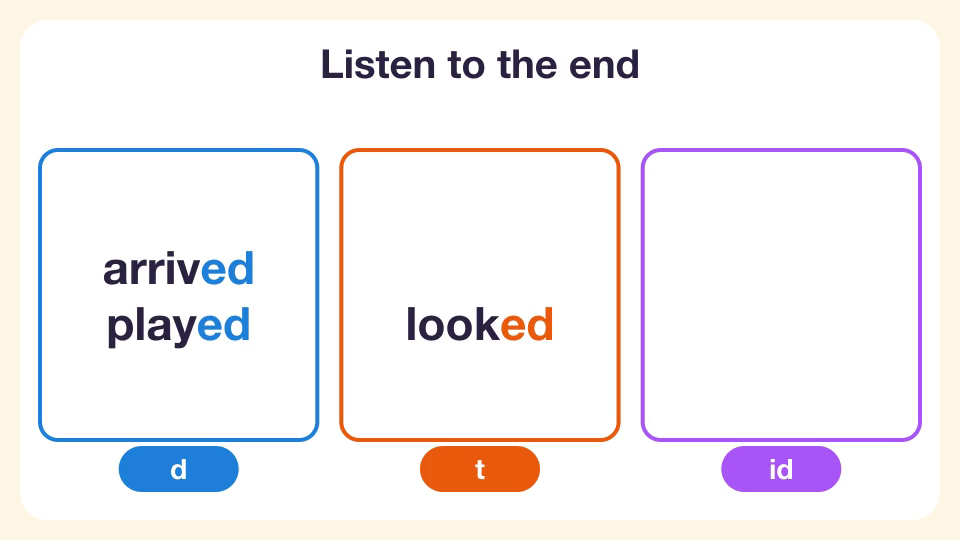
Listening comes first. Some rooms use short videos, such as this one, where words land in three boxes as the voice says them, so your child hears the three endings of played, looked and wanted.
Seven ways to practise speaking at home
- A few minutes a day. One or two speaking steps make a good daily habit.
- Listen twice first. Let your child play the model twice before recording.
- Say it together. Say the phrase with your child the first time; it is good practice for you too.
- Whisper, then speak. Shy children often find whispering the phrase first easier.
- Copy the music. Clap the strong syllables together: "a STU-dent".
- Slow, then natural. Say it slowly once, then at normal speed.
- Praise the try, not the score. A child who speaks a little every day keeps going.
Is my child's voice stored?
The recording is turned into text to score the step, then deleted. A child's recording is kept only if a parent allows it. Details are in StuCent's privacy policy.
Try it
In the younger version of the first room, "I am, you are", the project ends with eight short phrases to say aloud: a gentle first try for any beginner.
Try the speaking step in the first room (create an account first, so your child's stars are saved).
New to the English city? Start with the tour of the English city.
FAQ
What age is this for?
Any child who can listen and repeat. From A1 to B1, the city has its own rooms for younger children (about 6 to 11); teens have their own rooms at every level.
Can my child do this if I do not speak good English?
Yes. Every phrase is spoken first by a clear voice, so your child copies the model, not you. StuCent's menus also come in 18 languages, including Bahasa Melayu, Chinese and Tamil.
Does my child need a microphone?
A phone, tablet or laptop with a built-in microphone is enough.